DTi is a professional chemical testing organization around you!
- Add to favorite
- Wechat

- Corporate Email
- CN
- EN

2026/85921.4.2026
COMMISSION REGULATION (EU) 2026/859
of 20 April 2026
amending Annex XVII to Regulation (EC) No 1907/2006 of the European Parliament and of the Council concerning the Registration, Evaluation, Authorisation and Restriction of Chemicals (REACH) as regards 2,4-dinitrotoluene in articles
(Text with EEA relevance)
THE EUROPEAN COMMISSION,
Having regard to the Treaty on the Functioning of the European Union,
Having regard to Regulation (EC) No 1907/2006 of the European Parliament and of the Council of 18 December 2006 concerning the Registration, Evaluation, Authorisation and Restriction of Chemicals (REACH), establishing a European Chemicals Agency, amending Directive 1999/45/EC and repealing Council Regulation (EEC) No 793/93 and Commission Regulation (EC) No 1488/94 as well as Council Directive 76/769/EEC and Commission Directives 91/155/EEC, 93/67/EEC, 93/105/EC and 2000/21/EC (1), and in particular Article 68(1) thereof,
Whereas:
(1)2,4-dinitrotoluene (‘2,4-DNT’), CAS No 121-14-2, EC No 204-450-0, is classified in accordance with Regulation (EC) No 1272/2008 of the European Parliament and of the Council (2) as a carcinogen, category 1B. In addition, 2,4-DNT was identified as substance of very high concern meeting the conditions of Article 57, point (a), of Regulation (EC) No 1907/2006 and added to Annex XIV to that Regulation. For that substance, it is not possible to set a Derived No-Effect Level (‘DNEL’) and therefore it is a non-threshold carcinogen. Entry 28 of Annex XVII to Regulation (EC) No 1907/2006 restricts the placing on the market and use of 2,4-DNT for supply to the general public, as a substance, as a constituent of other substance or in a mixture when the concentration of 2,4-DNT equal to or greater than 0,1 % by weight.
(2)2,4-DNT was included into Annex XIV to Regulation (EC) No 1907/2006, with a sunset date of 21 August 2015, specified in accordance with Article 58(1), point (c)(i), of that Regulation. No applications for authorisations were received for the use of 2,4-DNT as a substance on its own or in a mixture or for the incorporation of the substance into articles, which implies that the substance is not used in the Union, including in the production of articles.
(3)Authorisation requirements laid down in Regulation (EC) No 1907/2006 do not apply to imported articles. Therefore, articles containing 2,4-DNT, produced outside the Union and subsequently imported, can be found on the Union market. Such articles represent a potential source of exposure to 2,4-DNT.
(4)After the sunset date referred to in Article 58(1), point (c)(i), for a substance listed in Annex XIV to Regulation (EC) No 1907/2006, Article 69(2) of that Regulation requires the European Chemicals Agency (‘the Agency’) to consider whether the use of that substance in articles poses a risk to human health or the environment that is not adequately controlled and, if the Agency considers this to be the case, to prepare a dossier for a restriction proposal which conforms to the requirements of Annex XV to Regulation (EC) No 1907/2006 (‘the Annex XV dossier’).
(5)Following an assessment of the available evidence in accordance with Article 69(2) of Regulation (EC) No 1907/2006, the Agency considered that there are uses of 2,4-DNT which may lead to a risk from the presence of this substance in articles that is not adequately controlled. Consequently, the Agency prepared an Annex XV dossier (3) which was published on 24 June 2021.
(6)The Annex XV dossier, which was amended and finalised on 9 September 2022 (4) (‘the dossier’) identified current or past uses of 2,4-DNT in various articles, including in refractory products, in automotive airbags, in seat belt pre-tensioners, in plastic bottles used in industrial settings for sample taking purposes, as propellants for military and civil small-arms ammunitions and as gelatinising-plasticising agent in explosive compositions. The Agency has received two notifications of a substance in articles in accordance with Article 7(2) of Regulation (EC) No 1907/2006 for 2,4-DNT: (i) as plasticiser in plastic sample bottles used at industrial settings, for which the notifying entity has now ceased to exist; and (ii) in propellants for military ammunition articles.
(7)According to the dossier, a search of the database for information on substances of concern in products established under Directive 2008/98/EC of the European Parliament and of the Council (5) for 2,4-DNT indicated that there are articles in the Union containing that substance in vehicles, ceramic articles and electronic devices. That information confirms that there are other articles, possibly imported, that contain the substance. The use of 2,4-DNT in seat belt pre-tensioners and ammunition was confirmed during the consultation on the Annex XV dossier.
(8)The dossier reported that there are consumer and professional uses of 2,4 DNT in articles where release of and exposure to 2,4-DNT cannot be excluded, and risk management measures are difficult to implement. For example, as traces of 2,4-DNT can be found in refractory articles, exposure from 2,4-DNT in such articles cannot be excluded. Exposure may also occur from the use of civilian small arms ammunition such as hunting and sports shooting, if the ammunition propellant contains 2,4-DNT. Shooting of the firearm does not consume all 2,4-DNT in the ammunition and inhalation and dermal exposure may occur. Two other uses with exposure potential concern motor vehicles safety systems and refer to (i) seat belt pre-tensioners, where an explosive charge causes the gas generator to produce a volume of gas and thus pressure, which then acts on a mechanical linkage to pull the seat belt; and (ii) airbags, where deployment releases gas in a similar manner as in pre-tensioners. For uses of 2,4-DNT in motor vehicle safety systems, groups at risk of exposure include, in addition to the driver and passengers, for example car repair technicians or, in case of an accident, the rescue forces. Due to such uses, inhalation and dermal exposure may occur. In addition, the Agency considered that the exposure potential of 2,4-DNT as plasticiser in plastic articles and as additive in any plastic material can be considered high. Based on its physical-chemical properties, 2,4-DNT is assumed to diffuse easily in the plastic matrix and partition from surface to contact medium (water, saliva or skin). Consequently, exposure to 2,4-DNT from using plastic sample bottles cannot be excluded.
(9)As 2,4-DNT is a non-threshold carcinogen for which no DNEL can be derived, the dossier concluded that 2,4-DNT incorporated in articles poses a risk to human health for consumers and professional users that is not adequately controlled. It further concluded that, where there are articles exposing consumers and professional users to 2,4-DNT, the only way to manage the risk is to limit the presence of 2,4-DNT in the articles themselves. To this end, the dossier proposes to restrict the placing on the market and use of 2,4-DNT in articles for consumer and professional uses outside of industrial sites, given that, for those uses: (i) release of and exposure to 2,4-DNT cannot be excluded; and (ii) risk management measures are difficult to implement.
(10)The dossier set the concentration limit of 2,4-DNT to 0,1 % by weight or above to prevent the intentional addition of 2,4-DNT in articles in the Union and to ensure that imported articles meet the same standard as articles originating in the Union.
(11)The dossier excluded uses taking place at industrial sites from the scope of the proposed restriction because the Agency assumed that appropriate and effective operational conditions and risk management measures can be implemented at those sites and risks are well controlled. Moreover, the dossier excluded explosives from the scope of the proposed restriction, as: (i) the Agency assumed that these products are well-regulated by other Union legislation; and (ii) relevant measures are in place for handling of explosives that are expected to limit any exposure to 2,4-DNT to workers or the environment. Ammunition for use, in accordance with national law, by the military, the police and other security forces, was also excluded from the scope of the proposal to ensure that the defence capability in Member States is not negatively affected.
(12)The dossier proposed to exempt from the scope of the restriction also articles for which the presence of carcinogens is regulated by Union legislation, in particular Regulation (EU) 2025/2509 of the European Parliament and of the Council (6) on the safety of toys and repealing Directive 2009/48/EC, and Regulation (EU) 2017/745 of the European Parliament and of the Council (7) on medical devices. It also proposed to exempt articles covered by Regulation (EC) No 1935/2004 of the European Parliament and of the Council (8) on food contact materials because 2,4 DNT is already regulated in plastic food contact materials.
(13)The dossier concluded that alternatives to 2,4-DNT exist for all the uses identified in it, and a 12-month transitional period before the restriction starts applying would be sufficient time for importers to adapt their supply chain and transition to articles not containing 2,4-DNT. As there is no Union production of articles containing 2,4-DNT, the only Union actors that would need to transition to alternatives or use up stocks are importers.
(14)On 2 June 2022, the Agency’s Committee for Risk Assessment (‘RAC’) adopted its opinion confirming that there is a risk to human health that is not adequately controlled for uses of 2,4-DNT in articles. The RAC concluded that, in terms of its effectiveness, practicality and monitorability, the restriction as proposed by the Agency, is the most appropriate Union-wide measure to address the identified risks to consumers and professionals working outside of industrial sites arising from exposure to 2,4-DNT.
(15)RAC considered that the definition of ‘explosives’ proposed by the Agency is not sufficient to define the explosives that should be excluded from the scope of the restriction. Specifically, RAC considered that it should be made clear that explosives are those defined in Directive 2014/28/EU of the European Parliament and of the Council (9), and that pyrotechnic articles (which should be in the scope of the restriction) are those defined in Article 3, points (1) to (4), of Directive 2013/29/EU of the European Parliament and of the Council (10).
(16)RAC agrees with the scope of the restriction as proposed by the Agency.
(17)On 9 September 2022, the Agency’s Committee for Socio-Economic Analysis (‘SEAC’) adopted its opinion, concluding that the proposed restriction, as modified by RAC and SEAC, is the most appropriate Union-wide measure to address the identified risks linked to 2,4-DNT, taking into account its socioeconomic benefits and costs.
(18)SEAC agreed with the dossier that a 12-month deferral of the application of the restriction would provide sufficient time to stakeholders to fully implement the restriction requirements. SEAC however recommended a 36-month transitional period for the application of the restriction to the use of 2,4-DNT in micro gas generators for seat belt pre-tensioners and bonnet actuators and in spare parts in the automotive sector, to ensure the phase out of the use of the substance in motor vehicles whilst considering the safety of users and minimising any major economic impact.
(19)The Agency’s Forum for Exchange of Information on Enforcement, referred to in Article 76(1), point (f) of Regulation (EC) No 1907/2006, was consulted and its recommendations have been taken into account.
(20)On 16 December 2022, the Agency submitted the opinions of RAC and SEAC (11) to the Commission.
(21)Taking into account the dossier and the opinions of RAC and SEAC, the Commission concludes that exposure to 2,4-DNT in articles poses an unacceptable health risk to the general public and professional users, and that that risk needs to be addressed on a Union-wide basis. It is therefore appropriate to introduce a restriction on the placing on the market and use of 2,4-DNT in articles. The Commission follows the opinions of RAC and SEAC on the need for professional users operating outside of industrial sites to be covered by the restriction to address the identified risks, and for a more precise definition of which explosives should be excluded from the scope of the restriction. In view of the fact that 2,4-DNT is also used in missiles, warheads, equipment for distress signals and in other military uses, the Commission considers appropriate to extend the exemption for ammunition for military use, proposed by the Agency, to cover all articles for military use (12).
(22)To avoid unnecessary recalls and waste, motor vehicles containing 2,4-DNT that are placed on the market within two years after the date of application of this restriction, by virtue of the deferred application of the restriction to certain motor vehicle applications, may continue to be placed on the market and used until the end of their service life.
(23)To avoid unnecessary recalls and facilitate enforcement, the restriction should not apply to articles that were placed on the market in the Union before the date of application of the restriction, such as second-hand articles.
(24)Stakeholders and Member States should be allowed sufficient time to comply with the restriction. The Commission therefore considers that the application of the restriction should be deferred by 12 months, as recommended in the dossier, except for the provisions concerning micro gas generators for seat belt pre-tensioners, bonnet actuators and spare parts in motor vehicles, which should apply after 36 months, in line with the SEAC opinion.
(25)Regulation (EC) No 1907/2006 should therefore be amended accordingly.
(26)The measures provided for in this Regulation are in accordance with the opinion of the Committee established under Article 133 of Regulation (EC) No 1907/2006,
HAS ADOPTED THIS REGULATION:
Article 1
Annex XVII to Regulation (EC) No 1907/2006 is amended in accordance with the Annex to this Regulation.
Article 2
This Regulation shall enter into force on the twentieth day following that of its publication in the Official Journal of the European Union.
This Regulation shall be binding in its entirety and directly applicable in all Member States.
Done at Brussels, 20 April 2026.
For the Commission
The President
Ursula VON DER LEYEN
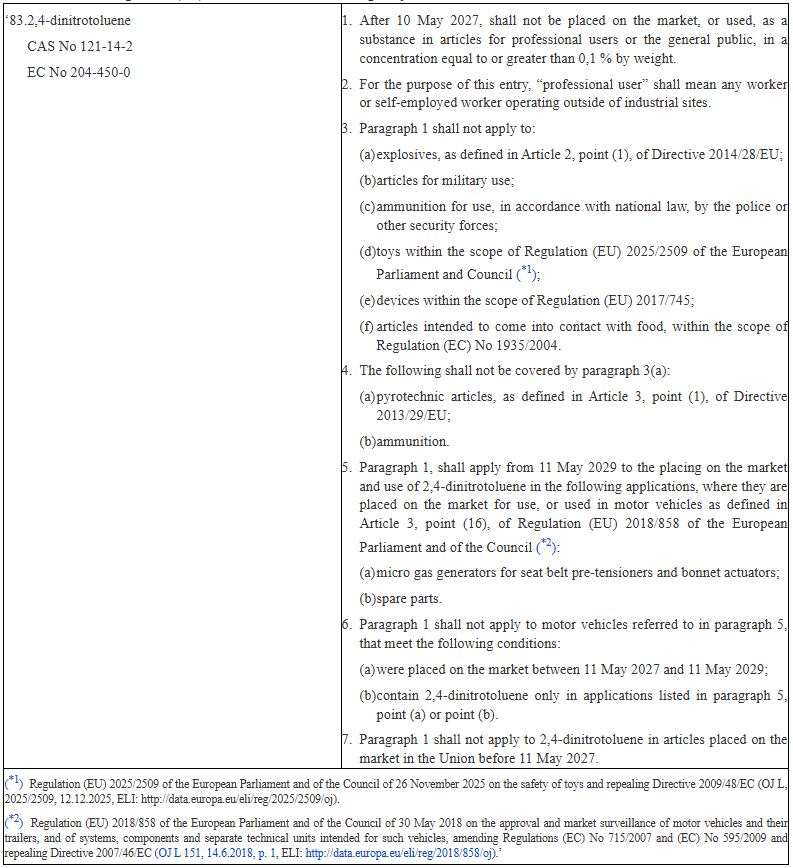
In Annex XVII to Regulation (EC) No 1907/2006, the following entry is added:

Official website email: dti@deesev.cn
Testing consultation email:wangtui@deesev.cn
the public

Quote QR code
 Shen Gongwang Security: 44030602006947
报价二维码
